What Makes Shikaku So Relaxing Yet Challenging?
what is shikaku puzzle, shikaku explained, how to solve shikaku, shikaku logic puzzle, shikaku rules, shikaku brain benefits, relaxing logic puzzles, spatial reasoning puzzle, rectangle puzzle game, Nikoli puzzles, shikaku for beginners, shikaku tips, Japanese logic puzzles, Calc Quest shikaku, visual logic puzzle
Most puzzles make you choose between relaxing and challenging. Shikaku refuses to pick one.
There's a specific kind of puzzle that hits differently from all the others. Not the ones that make your heart race with a ticking timer. Not the ones so easy they require no thought at all. The ones that sit in a rare middle ground where you feel genuinely calm while also thinking harder than you expected.
Shikaku lives in that middle ground. It's visually clean, logically satisfying, and surprisingly deep. And once you understand what's actually happening inside it, you'll understand exactly why it produces that unusual combination of feelings that keeps people coming back.

"Shikaku is the puzzle equivalent of a long, quiet walk that somehow takes you further than you planned. Effortless in feeling. Substantial in effect."
What Is Shikaku?
What it is: Shikaku is a Japanese logic puzzle played on a rectangular grid. Numbers are placed in certain cells of the grid. Your goal is to divide the entire grid into rectangles including squares so that each rectangle contains exactly one number, and that number equals the area of the rectangle it's in.
A simple example: If a cell contains the number 6, the rectangle surrounding it must contain exactly 6 cells and it could be 1x6, 2x3, 3x2, or 6x1 in shape. Your job is to figure out which orientation fits correctly given the constraints of the surrounding numbers.
Every cell in the grid must belong to exactly one rectangle. No overlaps. No gaps. No cells left unassigned. When the puzzle is complete, the grid is perfectly tiled a satisfying arrangement of interlocking rectangles that fits together like a visual jigsaw.
The name "Shikaku" comes from the Japanese word for rectangle. It was popularised by Nikoli, the Japanese puzzle publisher responsible for bringing Sudoku to the world. Nikoli has a long history of identifying puzzles with clean rules and deep logic and Shikaku is one of their finest.
The Rules - As Simple As They Get
Shikaku has three rules. Once you understand them, you can start immediately.
Rule 1 — Divide the grid into rectangles. Every region you create must be a perfect rectangle or square no L-shapes, no T-shapes, no irregular regions of any kind.
Rule 2 — Each rectangle contains exactly one number. The numbered cells are your clues every rectangle is defined by its number, and each number belongs to exactly one rectangle.
Rule 3 — The number equals the area. A cell containing 4 belongs to a rectangle with 4 cells total. A cell containing 9 belongs to a rectangle with 9 cells. The number and the area are always identical.
Tip: Start with the numbers that have the fewest possible rectangle shapes. A cell containing 2 can only be a 1x2 or 2x1 rectangle just two options. A cell containing a prime number like 7 can only be 1x7 or 7x1. These heavily constrained numbers are almost always your entry point.
Why Shikaku Feels Relaxing
The Visual Language Is Immediately Comfortable
Rectangles are one of the most visually comfortable shapes the human brain encounters. We live in a world of rectangles rooms, screens, books, windows, doors. Our spatial reasoning is deeply calibrated to rectangular forms, which means working with them in a puzzle feels intuitive rather than alien.
When you draw a rectangle on a Shikaku grid, it fits cleanly. It has straight edges. It aligns with the grid. There's nothing irregular or awkward about it. That visual cleanliness creates a sense of orderliness that most puzzles with irregular shapes never achieve.
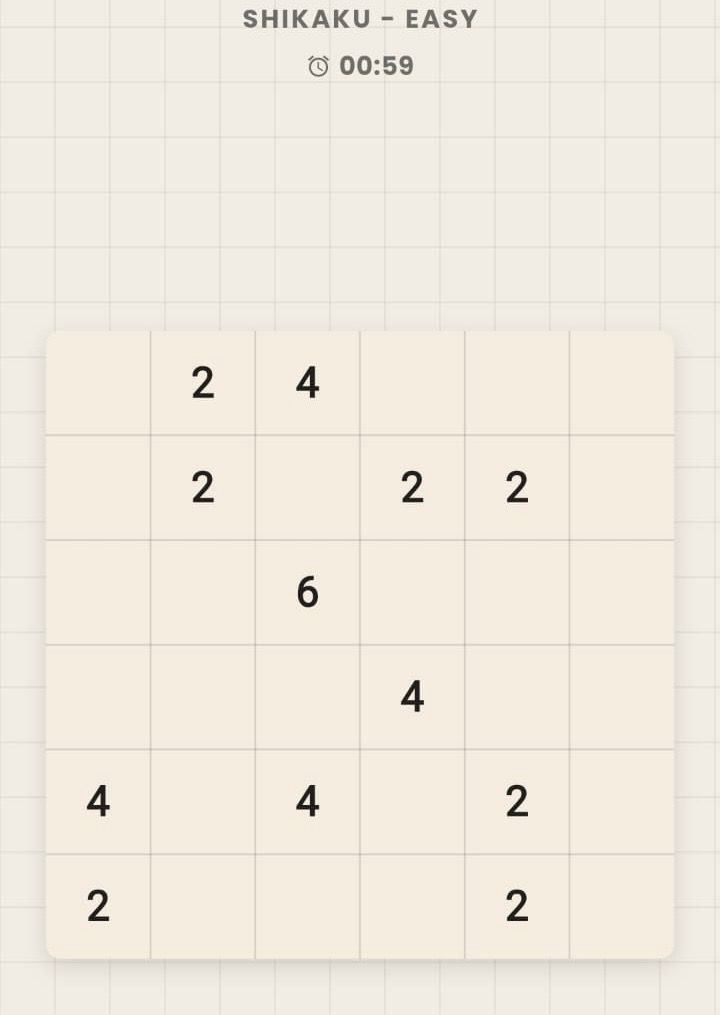
Progress Is Always Visible
Every rectangle you complete is visually distinct outlined, shaded, or marked clearly on the grid. As you solve, the grid fills with clean rectangular regions and the remaining space shrinks visibly. You can see exactly how much you've done and exactly how much remains at every stage.
That visible progress is deeply satisfying in a way that's easy to underestimate. Many puzzles feel opaque mid-solve you're working but you can't tell if you're getting closer. Shikaku never feels that way. The grid tells you where you are at every moment.
There's No Time Pressure in the Logic Itself
Shikaku doesn't require fast thinking. It requires careful thinking considering the possible shapes for each number, checking how those shapes interact with neighbouring numbers, and finding the arrangement that satisfies every constraint simultaneously. That process is inherently deliberate and unhurried.
The calm that comes from a Shikaku session isn't passive. Your brain is genuinely engaged. But it's engaged in a way that feels measured rather than frantic more like fitting together the pieces of a spatial puzzle than racing against anything.
"Shikaku gives your brain something real to do without making it feel rushed. That combination genuine engagement without urgency is rarer in puzzle design than it should be."
Why Shikaku Is More Challenging Than It Appears
The Shapes Interact in Non-Obvious Ways
Each rectangle in Shikaku doesn't exist in isolation. The shape you choose for one number directly determines which cells are available to the numbers around it. A rectangle that extends to the right might cut off the only valid space for a neighbouring number. A rectangle that goes downward might create an awkward region that can't be filled by any valid rectangle.
These interactions are the source of Shikaku's real depth. On a small grid they're manageable. On a larger grid they multiply quickly a single shape decision early in the solve can cascade through five or six neighbouring numbers, creating consequences you didn't anticipate when you made the original move.
Some Numbers Have Many Possible Shapes
A number like 12 can be arranged as a 1x12, 2x6, 3x4, 4x3, 6x2, or 12x1 rectangle six possible shapes, each fitting differently into the grid. Working out which of those shapes is actually valid in context given the grid boundaries and the other numbers nearby is a genuine logical exercise that requires holding multiple possibilities in mind simultaneously.
For smaller grids, this is manageable. For larger grids with many high numbers, the combinatorial complexity grows rapidly and the puzzle begins to demand a systematic approach rather than intuitive trial and error.
The Grid Must Be Perfectly Tiled- No Exceptions
Every single cell in the grid must belong to exactly one rectangle. There are no spare cells, no buffer zones, no cells you can leave unassigned. This total coverage requirement is what prevents guessing from working reliably a rectangle that looks correct in isolation might leave one or two cells unassignable, which means the entire arrangement needs to be reconsidered.
That unforgiving completeness is what gives Shikaku its satisfying finish. When the grid is fully tiled and every number matches its rectangle's area, the solution is unambiguous and visually beautiful. But getting there requires every single decision to be correct.
Did you know? Shikaku puzzles are computationally classified as NP-complete meaning that for very large grids, even computers struggle to find solutions efficiently. The same category includes famous hard problems in mathematics and computer science. Your 10x10 Shikaku is, technically, a member of one of the most studied problem classes in all of computing.

What Shikaku Builds in Your Brain
Spatial Reasoning
Shikaku is fundamentally a spatial puzzle. Visualising how rectangles of different dimensions fit into a constrained grid and how changing one rectangle's shape affects the space available to its neighbours is a pure spatial reasoning task. Regular Shikaku practice measurably strengthens the mental systems used for navigation, geometry, visualisation, and any task that requires thinking about how physical things fit together in space.
Area and Multiplication Intuition
Every Shikaku puzzle is a practical lesson in area the relationship between a rectangle's dimensions and its total size. Players who solve Shikaku regularly develop an intuitive feel for how dimensions and areas relate knowing instantly that a 12-cell rectangle could be 3x4 or 2x6, or that a 7-cell rectangle must be 1x7 because 7 is prime.
That number intuition, built through spatial practice rather than rote memorisation, transfers directly to mental arithmetic, estimation, and any task that involves thinking about quantities in physical terms.
Systematic Thinking
Shikaku teaches you to think through possibilities systematically rather than acting on the first shape that comes to mind. Listing all valid dimensions for a number, checking each against grid boundaries and neighbouring constraints, and eliminating invalid options before committing this disciplined process is the same one used in engineering, planning, and any field that requires finding solutions within strict constraints.
Fun fact: Shikaku was one of the original puzzles published by Nikoli in the 1980s the same publisher that refined and popularised Sudoku globally. Nikoli has a strict editorial standard: every puzzle they publish must be solvable by pure logic, with no guessing required. Every Shikaku puzzle meets that standard. There is always one clean, logical path to the solution.
How to Solve Shikaku - A Practical Guide
Step 1 — Find the most constrained numbers first. Look for numbers that have very few possible rectangle shapes prime numbers, numbers near the edge of the grid, and small numbers like 2 and 3. These are your entry points. Solve them first and use them to constrain the numbers around them.
Step 2 — Check grid boundaries immediately. A number near the edge or corner of the grid has far fewer valid rectangle orientations than one in the centre. A 6 in the corner of a grid cannot extend in two of its four possible directions which might reduce its six possible shapes to just one or two.
Step 3 — List all valid dimensions before placing. For each number, work out every possible rectangle dimension that fits within the grid. Then eliminate any that would conflict with adjacent numbers or leave uncoverable gaps. What remains is your valid set and often it contains only one option.
Step 4 — Watch for uncoverable regions. As you place rectangles, keep an eye out for small irregular spaces forming between them. A 1x1 gap with no number in it is impossible to cover which means a nearby rectangle needs to be reshaped. Spotting these early prevents you from building on a flawed foundation.
Step 5 — Trust the logic all the way to the end. Every Shikaku puzzle has exactly one correct solution reachable through pure logic. If you're stuck, the answer is always more elimination more careful checking of what's truly possible not guessing. The solution is always there. The logic always leads to it.
Who Is Shikaku For?
For anyone who finds Sudoku too abstract: Shikaku's spatial, visual nature makes it feel more concrete and intuitive. You're working with shapes you can see and areas you can count which grounds the logic in a way that pure number placement doesn't always achieve.
For visual thinkers: If you think in pictures and spaces rather than in abstract rules, Shikaku is designed for your kind of mind. Every decision has a visual consequence you can see immediately which makes the logic feel natural rather than imposed.
For people who want to unwind without switching off: Shikaku is the rare puzzle that genuinely relaxes you while keeping your brain meaningfully engaged. It's not passive entertainment but it doesn't feel like work either. That balance is exactly what makes it so valuable as a daily mental habit.
For puzzle lovers ready for something new: If you've exhausted Sudoku and Nonograms and want a format that feels fresh while using the same logical instincts you've already developed Shikaku is your next puzzle. Different enough to be genuinely new. Logical enough to feel immediately familiar.
"Shikaku is what happens when a puzzle is designed with complete respect for the solver. Clear rules. Logical solutions. Satisfying results. No tricks. No ambiguity. Just geometry and thinking."
The Grid Is Waiting
Shikaku rewards patience, spatial thinking, and the willingness to work through possibilities systematically rather than rushing to the first answer that comes to mind. It gives back exactly as much as you put in and it does so in one of the most visually satisfying puzzle formats ever designed.
The grid starts empty. The numbers are your clues. The rectangles are waiting to be drawn.
Find where the first one goes. The rest will follow.