Tango Puzzle: Simple Rules, Endless Strategy
tango puzzle explained, what is tango puzzle, how to solve tango puzzle, tango logic game, tango puzzle rules, tango puzzle strategy, binary logic puzzle, sun moon puzzle, tango puzzle tips, LinkedIn tango puzzle, two symbol logic puzzle, Takuzu puzzle, brain training logic puzzle, Calc Quest tango, tango puzzle for beginners
Two symbols. One grid. Rules you can explain in a sentence. Strategy that takes considerably longer to master.
The Tango Puzzle belongs to a rare category of games where the entry barrier is almost nonexistent and the depth is almost inexhaustible. You learn the rules in under a minute. You spend the next ten minutes wondering why it's harder than it looked. And somewhere in that gap between how simple it sounds and how much it demands is where the puzzle becomes genuinely compelling.
This is everything you need to know about Tango: what it is, how it works, why the strategy runs so much deeper than the rules suggest, and what it quietly does to your brain every time you sit down with it.
"Tango is the kind of puzzle that makes you feel clever for understanding the rules and then immediately humbles you for thinking that was the hard part."
What Is the Tango Puzzle?
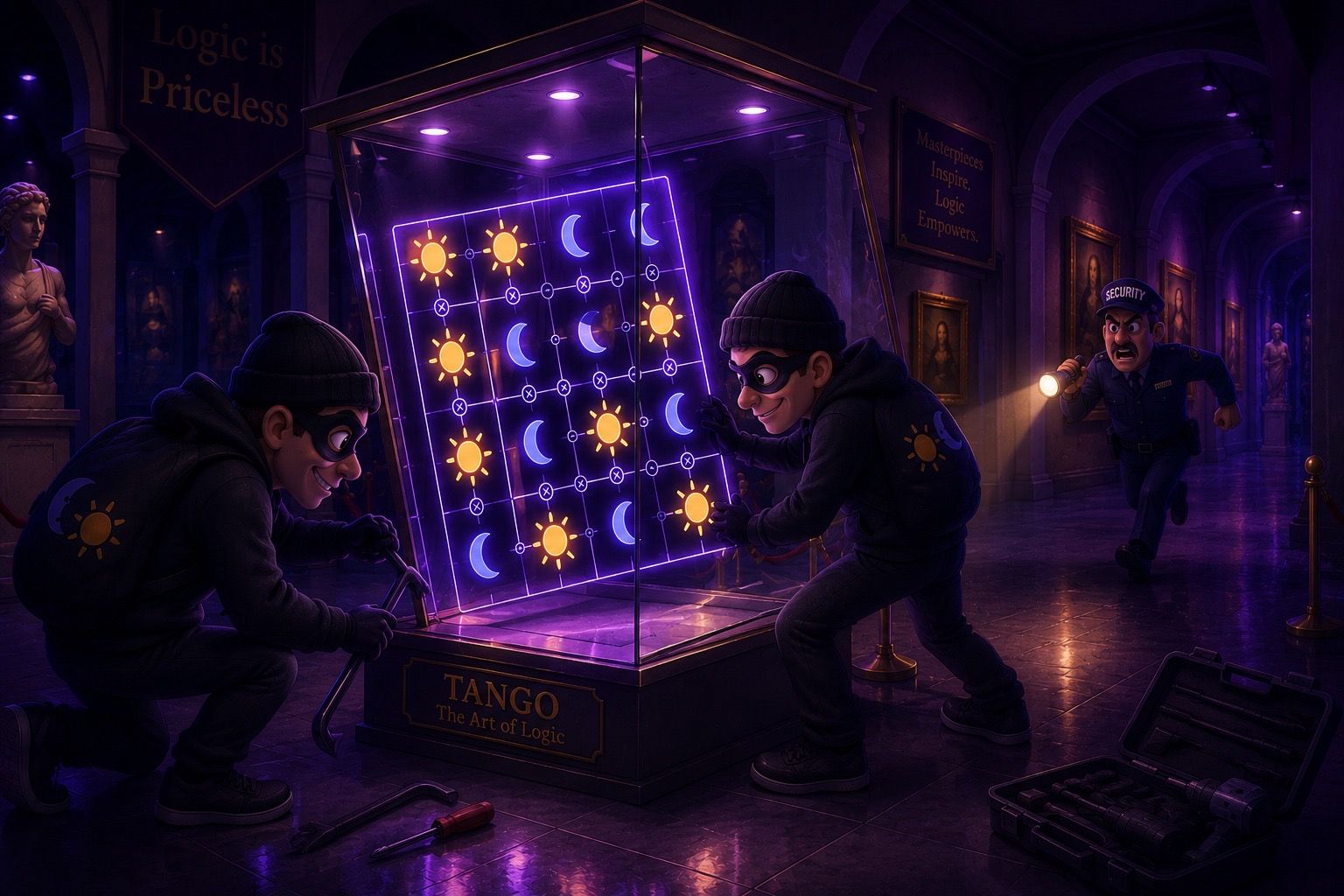
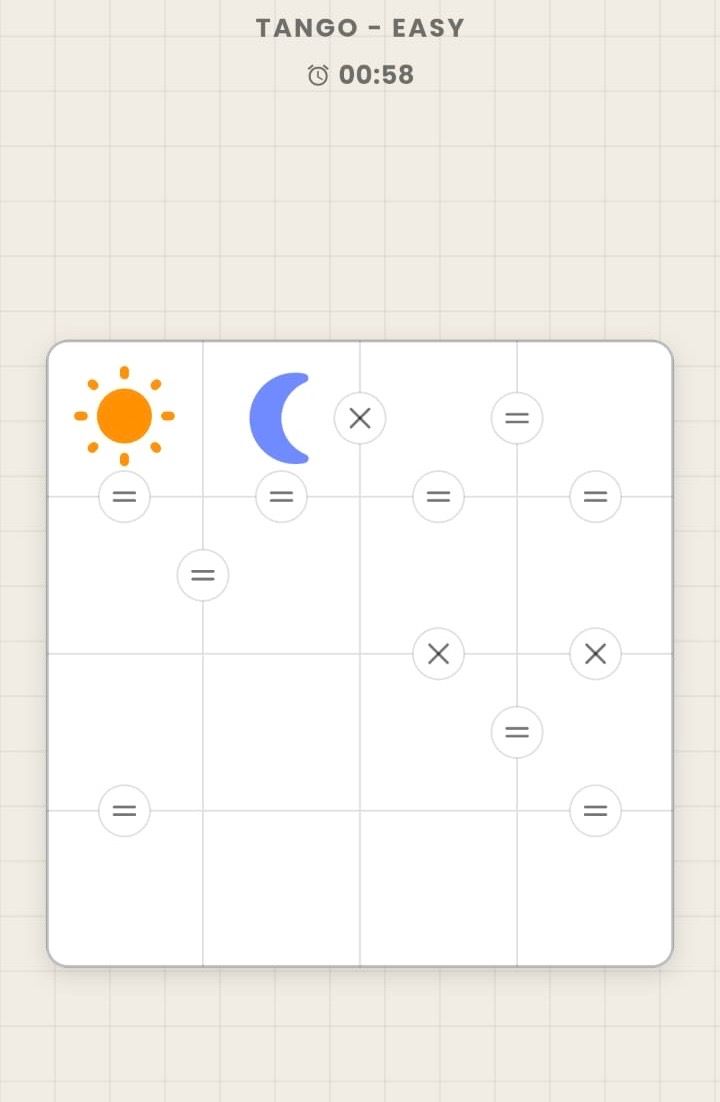
What it is: The Tango Puzzle is a grid-based logic puzzle where you fill every cell with one of two symbols typically represented as sun and moon, or light and dark following a small set of rules about how those symbols can be arranged. The goal is to find the one valid arrangement that satisfies every rule simultaneously.
Where it comes from: Tango was introduced by LinkedIn as a daily puzzle game and quickly became one of the most discussed logic puzzles of its moment praised for being genuinely satisfying without being intimidating. It draws on the same design philosophy as binary puzzles and Takuzu, but wraps the logic in a cleaner, more accessible format that rewards both casual and serious puzzle players.
The two-symbol approach is deceptively powerful. With only two options per cell, you might expect the puzzle to feel limited. What you discover quickly is that the constraints interact in ways that create far more complexity than two choices should logically allow.
💡 The name "Tango" reflects the puzzle's essential dynamic two elements in close, structured relationship with each other. Like the dance, the puzzle is about balance, constraint, and finding the right movement within a defined space.
The Rules - Everything You Need to Know in Three Points
Rule 1 - No three in a row. Three identical symbols cannot appear consecutively in any row or column. Two suns in a row is fine. Three suns in a row is not in any direction, horizontal or vertical.
Rule 2 - Equal numbers of each symbol. Every row and every column must contain exactly the same number of suns and moons. On a 6×6 grid, that means three of each in every row and column. On an 8×8 grid, four of each.
Rule 3 - Follow the edge clues. Some versions of Tango include clues between adjacent cells indicators that show whether two neighbouring cells must contain the same symbol or opposite symbols. These clues provide the starting constraints that make each puzzle unique and logically solvable from scratch.
Three rules. Two symbols. One correct solution always reachable through pure logic, never requiring a guess.
💡 Tip: The "no three in a row" rule is your most powerful tool. The moment you place two identical symbols next to each other in any row or column, the cell immediately before and after them is forced it must be the opposite symbol. Use this forced placement aggressively from your very first moves.
Why the Strategy Runs Deeper Than the Rules
Two Symbols Create More Complexity Than You Expect
The counterintuitive truth about two-symbol puzzles is that having fewer options doesn't make the logic simpler it makes the constraints tighter. Every cell you place generates an immediate ripple. Every sun placed in a row changes the balance of that row and the options available to every other cell in it. Every moon placed in a column constrains the column in multiple directions simultaneously.
With more symbols like the nine in Sudoku a wrong placement might not create a visible contradiction until several moves later. With two symbols, contradictions surface faster and more clearly, which makes the feedback loop immediate and the strategy more precise.
The Three Rules Interact in Non-Obvious Ways
Individually, each rule is straightforward. But the three rules working simultaneously create logical interactions that beginners rarely anticipate. The "no three in a row" rule limits local arrangements. The "equal numbers" rule constrains global balance. The edge clues link specific cells directly.
A move that satisfies one rule perfectly can violate another rule two or three steps down the chain. Tracking all three constraints simultaneously locally and globally, in both rows and columns at the same time is where the strategic depth lives. And it's where most beginners discover the puzzle is significantly harder than they assumed.
The Puzzle Has Exactly One Solution Which Means Every Move Matters
Unlike puzzles where multiple valid solutions exist, Tango always has exactly one correct arrangement. This means every cell has a definitively correct answer and every incorrect placement, however plausible it seemed, will eventually create a contradiction somewhere in the grid.
That single-solution property transforms the puzzle from an exploration into a logical proof. You're not finding an arrangement that works you're finding the arrangement that must be correct. That precision is both what makes Tango demanding and what makes solving it feel so unambiguously satisfying.
"When a Tango puzzle clicks into place every cell filled, every rule satisfied, not a single contradiction anywhere it doesn't just feel finished. It feels correct. That's a different and better feeling."
The Strategies That Actually Work
Force Every Placement You Can
The most reliable strategic move in Tango is to find forced placements cells where only one symbol is logically possible and fill them in before attempting anything else. Forced placements come from three sources: two identical symbols already adjacent in a row or column (forcing the opposite symbol on both sides), a row or column that already has its full quota of one symbol (forcing all remaining cells to be the other), and edge clues that directly determine a cell's symbol.
Finding and filling all forced placements first gives you a clearer picture of what remains and often reveals new forced placements that weren't visible before.
Work Rows and Columns Simultaneously
A common beginner mistake is to work through the puzzle row by row, solving each row before moving to the next. This misses half the information available. Every cell belongs to both a row and a column which means every placement creates constraints in two directions at once.
Experienced Tango solvers constantly switch between horizontal and vertical perspectives. A cell that seems unconstrained when you look at its row becomes immediately forced when you look at its column. That dual-perspective thinking is the single biggest skill difference between beginners and experienced players.
Use the Balance Rule Proactively
The equal-numbers rule becomes increasingly powerful as a row or column fills up. If a row on a 6×6 grid already has three suns placed, every remaining cell in that row must be a moon no further logic required. If a column has two moons and only one cell left that could be a moon, that cell is forced.
Track the running count of each symbol in every row and column as you place. The moment a row or column reaches its quota for one symbol, all remaining cells in that line are immediately resolved. This is one of the fastest ways to make progress in a stuck position.
When You're Stuck, Assume and Test
When no forced placements are visible, experienced solvers use a technique called "assume and test" tentatively placing a symbol in an uncertain cell and following the logical consequences to see if a contradiction appears. If it does, the opposite symbol must be correct. If it doesn't, you've made genuine progress.
This technique should be used sparingly and only after exhausting forced placements but it's a legitimate logical tool, not guessing. The key is to track your assumption clearly and be willing to revert cleanly if a contradiction emerges.
💡 Did you know? The "assume and test" technique is a formalised logical method used in mathematics and computer science under the name "proof by contradiction." Tango teaches it intuitively most players develop and use it naturally without ever knowing they're applying a classical logical proof technique.
What Tango Builds in Your Brain
Binary Reasoning
Tango is a masterclass in binary reasoning the ability to work through problems where every element has exactly two possible states and the correct state must be determined through elimination rather than selection. This form of reasoning underlies digital computing, logical proofs, decision trees, and any system where choices are yes-or-no, true-or-false, on-or-off.
Regular Tango practice builds fluency in binary logic that transfers directly to programming, analytical thinking, and any problem-solving context where clear-cut either-or decisions need to be made systematically.
Global and Local Thinking Simultaneously
Tango demands two types of attention at the same time: local attention to specific cells and their immediate neighbours, and global attention to the balance of entire rows and columns. Switching fluidly between these two scales of thinking zooming in to resolve a specific cell, then zooming out to check the global impact is a sophisticated cognitive skill that most activities never explicitly train.
Players who develop this dual-scale thinking in Tango often report that it shows up in other areas being able to track both details and the bigger picture simultaneously in work, planning, and complex decision-making.
Pattern Memory and Elimination
After solving many Tango puzzles, players begin to recognise common constraint patterns configurations of symbols that always produce the same forced consequences. Two suns followed by a gap always forces the gap to be a moon. A row with four suns and two cells remaining always fills those cells with moons. These patterns, once internalised, allow experienced players to process the grid far faster than beginners not because they're thinking differently, but because they're recognising more.
That progressive pattern recognition building a mental library through repeated exposure is exactly how expertise develops in any domain.
"The gap between a beginner and an experienced Tango solver isn't intelligence. It's pattern library. The more configurations you've seen, the faster the forced moves become obvious."
The Difficulty Curve — What to Expect
The First Few Puzzles
Early Tango puzzles have enough given clues to make forced placements abundant and the solution path relatively linear. You'll make progress quickly, feel the logic working cleanly, and reach a solution without needing to think too far ahead. These puzzles build familiarity with the rules and establish the basic habits tracking counts, using the three-in-a-row rule that harder puzzles will demand.
Intermediate Puzzles
As the number of given clues decreases, the forced placements become less obvious and the interactions between rows and columns become more complex. You'll encounter positions where no single move is immediately clear where you need to hold several possibilities in mind simultaneously and work out which one avoids contradiction.
This is the range where most players spend the majority of their time and where the most cognitive growth happens. It's challenging enough to require real effort but achievable enough to keep you coming back.
Advanced Puzzles
Advanced Tango puzzles have minimal given information just enough to guarantee a unique solution and require sustained multi-step reasoning with very few obvious forced placements. Solving them cleanly requires the full toolkit: aggressive forced-placement hunting, dual-perspective row-and-column thinking, balance tracking, and strategic assume-and-test when all else is exhausted.
Completing an advanced Tango puzzle is a genuinely satisfying intellectual achievement and the skills developed getting there transfer well beyond the puzzle itself.
"Advanced Tango is one of those rare experiences where you feel your thinking becoming more precise in real time. Each move is deliberate. Each consequence is tracked. The solution, when it comes, feels inevitable."
Who Is Tango For?
For complete beginners: The two-symbol format and clear rules make Tango one of the most accessible logic puzzles available. You don't need prior puzzle experience. You don't need to be good at math. You just need to be willing to think carefully and Tango will teach you how, one forced placement at a time.
For Sudoku players looking for a change: Tango uses the same logical instincts as Sudoku elimination, constraint tracking, forced placements but in a format that feels completely different. Two symbols instead of nine. Balance rules instead of uniqueness rules. The skills transfer immediately. The experience feels fresh.
For analytical thinkers: Binary reasoning, dual-scale attention, proof by contradiction Tango is built from the same logical building blocks as formal reasoning and analytical thinking. If you enjoy problems with clean, unambiguous answers that reward careful systematic thinking, Tango is almost certainly your puzzle.
For daily puzzle players: Tango scales well to short sessions. A beginner puzzle takes five to ten minutes. An advanced puzzle can take twenty to thirty. Either way, the session has a clear start, a logical middle, and a satisfying end making it ideal for a daily mental habit that fits into a schedule rather than dominating it.
"Two symbols. One grid. The rules take a minute. The mastery takes much longer. And the space between those two things is where all the best puzzles live."
Your First Tango Puzzle Awaits
Start with the edge clues. Find two identical symbols already adjacent in any row or column and force the symbols around them. Track the count of each symbol in every row and column from your first move. And when you reach a position where nothing seems forced look again. Something always is.
The rules are simple. The logic is deep. And the solution when you find it is always exactly right.